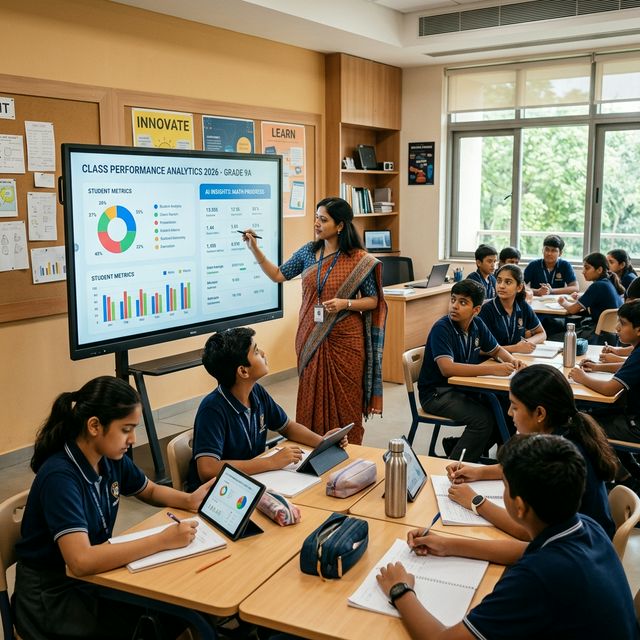
I want to be honest about something. When we started building Anubodha, we were not trying to "revolutionize education with AI." That phrase gets thrown around so loosely in pitch decks and LinkedIn posts that it has lost all meaning. What we were trying to do was much simpler: help a maths teacher in Surat stop spending her evenings filling out attendance registers by hand.
That is where this story begins. Not with a grand vision, but with a very specific, very human frustration.
The Real Problem Nobody Talks About
Walk into any mid-tier private school in Gujarat — the kind that charges ₹15,000–₹40,000 a year in fees — and you will see something that surprises most tech people. Teachers are still writing report cards by hand. Attendance is marked on paper and then manually entered into an Excel sheet at the end of the week. Fee collection involves a physical receipt book.
This is not a technology problem. Schools have tried software before. They have bought expensive ERPs from vendors who showed up, installed something, handed over a manual in English, and disappeared. The software sits unused. The Excel sheets come back.
The real problem is trust and design. Teachers do not trust systems that feel foreign. Parents do not trust platforms that send notifications in a language they do not fully understand. And principals do not trust tools that create more work instead of less.
What AI Actually Does in Our Schools Today
Let me give you three real examples from schools using Anubodha right now:
1. Automated Report Card Narratives
A Class 5 teacher in a Surat school has 48 students. Writing individual remarks on each report card used to take her two full weekends. Our AI looks at each student's attendance, grades across subjects, and participation data, and generates a personalized narrative draft. The teacher reviews it, edits what she wants, and approves. Total time: 45 minutes instead of two weekends.
2. Smart Attendance Anomaly Alerts
When a student who normally comes every day misses three days in a row, the system flags it to the class teacher and sends a gentle WhatsApp message to the parent. This is not fancy machine learning. It is pattern recognition applied with care. But it catches students who are slipping through the cracks — the ones no teacher has bandwidth to track across 50+ students.
3. Fee Reminder Intelligence
Instead of sending the same reminder to every parent, the system learns payment patterns. A parent who always pays in the first week of the month does not need a reminder. A parent who consistently pays late gets a softer, scheduled nudge. The principal told us this single feature reduced fee collection follow-ups by 60%.
The NEP 2020 Opportunity
India's National Education Policy 2020 explicitly calls for "appropriate integration of technology" in schools. But most schools do not know where to start. The CBSE and state boards are mandating digital record-keeping, but the tools available are either too expensive, too complex, or too Western in their design assumptions.
This is the gap we are trying to fill. Not with bleeding-edge AI that requires cloud GPUs, but with practical, Groq-powered intelligence that runs fast, costs little, and speaks the language of Indian education.
What We Are Building Next
Our upcoming features focus on what teachers have asked for most:
- Lesson Plan Suggestions — Based on syllabus progress and class performance data, suggest what to cover next
- Parent Communication in Gujarati/Hindi — AI-translated messages that sound natural, not robotic
- Offline-First Grading — Grade assignments on your phone without internet; sync when connected
None of these are moonshot features. They are pragmatic, teacher-requested improvements. And that is exactly the point.
The Bottom Line
AI in Indian education is not about replacing teachers. We have met too many incredible teachers to believe that. It is about giving them back the hours they lose to paperwork, so they can do what they became teachers to do — teach, mentor, and inspire.
If you are a school principal reading this, I would love to hear what your biggest daily frustration is. Not what vendor you are evaluating or what your board mandates. Just the thing that makes your best teacher stay late after school every day. That is where we want to help.