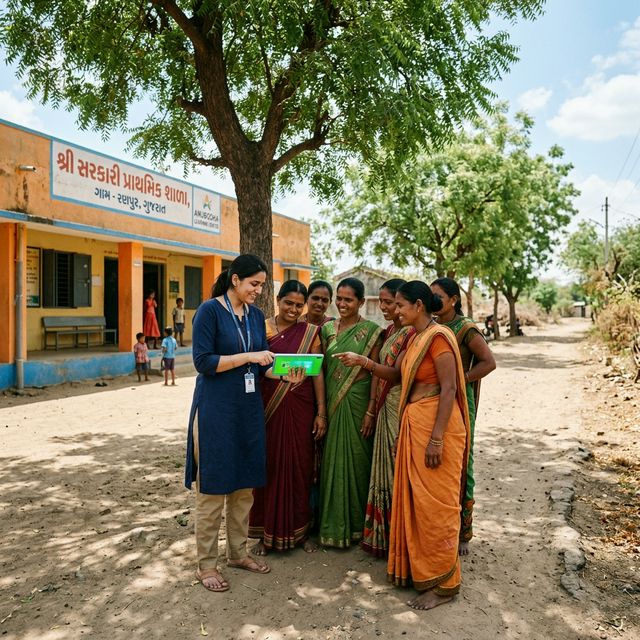
I am going to tell you a story about our worst demo and our best learning experience.
Three months ago, we drove to a small school about 180 kilometers from Surat. The school has 340 students, 12 teachers, and a principal — let us call him Mehta Sir — who has been running the school for 22 years. He agreed to meet us because a friend of his at a city school told him "this Anubodha thing is quite good."
We arrived at 10 AM with our laptops, a projector, and a carefully prepared demo. By 10:15 AM, we realized none of it was going to work the way we planned.
The Internet Problem
The school's internet was a mobile hotspot from the principal's personal phone. It would connect, load half a page, and drop. Our beautiful cloud-based demo stuttered and froze. The teachers looked at each other with expressions that clearly said, "See? This is why we use paper."
This was the moment that forced us to completely rethink our architecture. Up until that point, we had built Anubodha as a standard cloud application. Everything needed a connection. Standing in that school office with a frozen screen, we understood viscerally why that would not work for half of India.
What We Changed
Offline-First Attendance and Grading
We rebuilt our core workflows to work entirely offline. Teachers can mark attendance, enter grades, and log homework assignments without any internet connection. The data is stored locally on the device and syncs automatically whenever connectivity is available — even if that is just two minutes of 3G during lunch break.
WhatsApp-Based Parent Communication
In rural Gujarat, most parents do not check apps. But they check WhatsApp. So we integrated our notification system directly with WhatsApp. Attendance alerts, fee reminders, and exam schedules go straight to the parent's WhatsApp in Gujarati. No app download required. No login. No friction.
The "Anubodha Champion" Model
We stopped trying to train every teacher in one session. Instead, we identify the most tech-comfortable teacher in the school — usually someone under 30 who uses Instagram Reels — and turn them into the school's "Anubodha Champion." They get intensive training and become the go-to person for other teachers. This peer-support model has been far more effective than any manual or video tutorial we could produce.
The Surprise That Changed Our Thinking
Here is what we did not expect: the parents were the fastest adopters.
Mehta Sir told us that within the first week of going live, three parents came to the school specifically to say thank you. One mother — a daily wage worker who had never received a formal communication from the school — told him: "For the first time, I know exactly when my son was absent and what his marks are. I do not have to wait for the PTM."
That single moment justified every hour we spent rebuilding our offline architecture.
The Numbers After 3 Months
- Attendance marking time: Down from 15 minutes per class to 30 seconds
- Parent engagement: WhatsApp message open rate of 89% (compared to ~5% for the old printed circulars)
- Fee collection: On-time payment improved by 34% after automated Gujarati reminders
- Teacher satisfaction: 11 out of 12 teachers said they would "definitely recommend" the system to colleagues at other schools
What Rural Schools Taught Us About Building Software
After onboarding five rural schools, here are the principles that now guide every feature we build:
- Offline first, always. If it does not work without internet, it does not ship.
- Gujarati and Hindi first. English is the fallback, not the default.
- One screen, one action. No multi-step wizards. No nested menus. Teachers should be able to complete any task in under 3 taps.
- WhatsApp is the platform. Do not force parents to download another app. Meet them where they already are.
- Train one, reach ten. The champion model scales better than any help documentation.
We are now onboarding our 12th rural school. Each one teaches us something new. And with each one, we become a little bit better at building software that serves the India that most tech companies overlook.
If you know a school — urban or rural — that could benefit from what we are building, please ask them to reach out. We would love to visit.